


China Personal Protective Equipment Expo | Technology Guarding the Workplace: Smart Safety Helmets Reshaping Safety Management
China Personal Protective Equipment Expo recognizes that intelligence and technological advancement have become core development trends in the labor protection industry. Traditional safety helmets only provide basic physical protection and cannot meet the demands of modern safety production management.
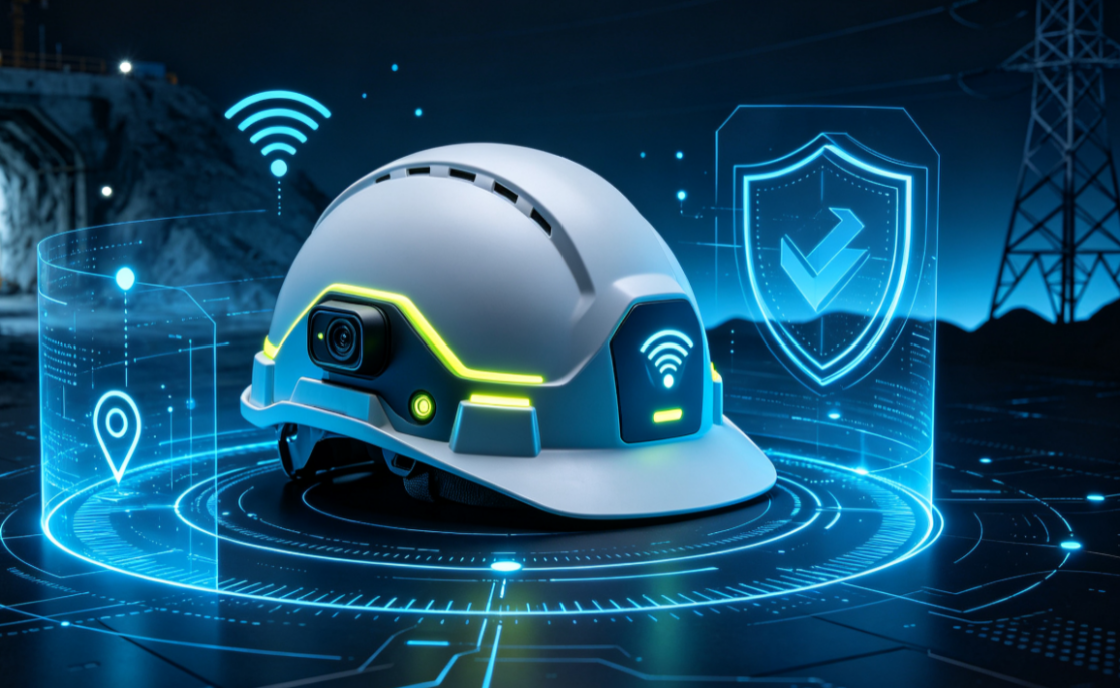
Smart safety helmets that integrate Internet of Things, artificial intelligence, 5G communication, and high-precision positioning technology break through the limitations of traditional protection, providing high-risk industries with intelligent and systematic new safety management solutions.
Current safety management for high-risk operations faces three prominent pain points. First, there are blind spots in on-site supervision. Mining sites, construction areas, and other workplaces cover extensive areas with high personnel mobility.
Management personnel cannot real-time track workers' locations and operational status. Most violations and safety hazards occur in these supervision blind spots, leaving safety management in a passive state of post-incident remediation and making proactive prevention difficult to achieve.
Second, communication efficiency between frontline and rear command is low. When frontline personnel encounter equipment failures or sudden emergencies, they can only report verbally via walkie-talkies or phones, unable to fully convey complex on-site conditions. Rear command personnel cannot intuitively grasp the actual situation, making precise problem assessment and rapid deployment difficult, which easily delays the optimal window for rescue and rectification.
Third, equipment and environmental adaptability is insufficient. Special operation conditions in explosive and flammable mining areas, high-temperature and high-humidity environments, and smoke-filled enclosed spaces are extremely demanding. Ordinary electronic devices pose safety risks, while traditional protective equipment lacks intelligent monitoring, data transmission, and remote linkage capabilities, failing to meet modern safety control requirements for special scenarios.
Addressing various industry pain points, smart safety helmets leverage cutting-edge technology to achieve comprehensive upgrades, adapting to different high-risk operation scenarios and filling the gaps of traditional equipment. For underground explosive and flammable environments, explosion-proof smart safety helmets comply with mining safety standards, fundamentally eliminating blasting risks caused by equipment and ensuring intrinsic operational safety. The devices support voice control and real-time video transmission, allowing workers to connect with command centers without stopping work or removing gloves, enabling rear command to intuitively grasp underground working conditions and quickly and precisely address hazards.
For positioning drift issues in tunnels and open-pit mines, high-precision smart safety helmets equipped with fused positioning technology can achieve centimeter-level accuracy, facilitating real-time personnel tracking for management personnel. The devices also feature intelligent posture monitoring that automatically identifies falls and abnormal working postures, triggering proactive alerts and rapidly initiating emergency rescue procedures to effectively reduce accident injuries.
For fire rescue and emergency response scenarios with obstructed visibility, infrared thermal imaging smart helmets demonstrate outstanding advantages. Binocular infrared thermal imaging technology can penetrate smoke and obstructions to detect heat sources, quickly locating trapped personnel and securing valuable rescue time. Combined with AR visualization capabilities, rescue plans and construction parameters can be overlaid onto the field of view, enhancing environmental perception and assessment capabilities, and significantly improving operational and rescue efficiency in complex scenarios.
The core value of smart safety helmets lies not only in hardware upgrades but in building an intelligent management system of “terminal + cloud + applications,” achieving the upgrade from single-point protection to comprehensive digital control. Low-latency audio and video interaction technology enables real-time frontline and rear linkage, allowing frontline operational challenges to quickly connect with rear experts for remote guidance, shortening fault resolution cycles. The supporting visual dispatch platform integrates positioning, video, and sensor multi-dimensional data, achieving integrated control of personnel, equipment, and on-site status, and driving safety management from passive response to proactive prevention.
As 5G, artificial intelligence, and Internet of Things technologies continue to evolve, smart safety helmet technology is becoming increasingly mature, establishing itself as core equipment for intelligent construction. It fundamentally reshapes safety management models in high-risk industries, driving the transition from experience-driven to data-driven safety management, comprehensively fortifying frontline operational safety defenses, and safeguarding stable safety production in high-risk industries.
Source: https://www.toutiao.com/article/7657468677403263524/?&source=m_redirect

