


Labor Protection Exhibition | AI Personal Protective Equipment Wear Detection System
Labor Protection Exhibition has learned that AI visual monitoring is becoming a mainstream supporting solution for safety management in modern factories. In manufacturing plants for electronics, chemicals, power, and precision processing—where electrostatic risks or high-hazard operations exist—properly wearing safety helmets, reflective vests, and anti-static workwear are foundational requirements for ensuring production safety and product quality.
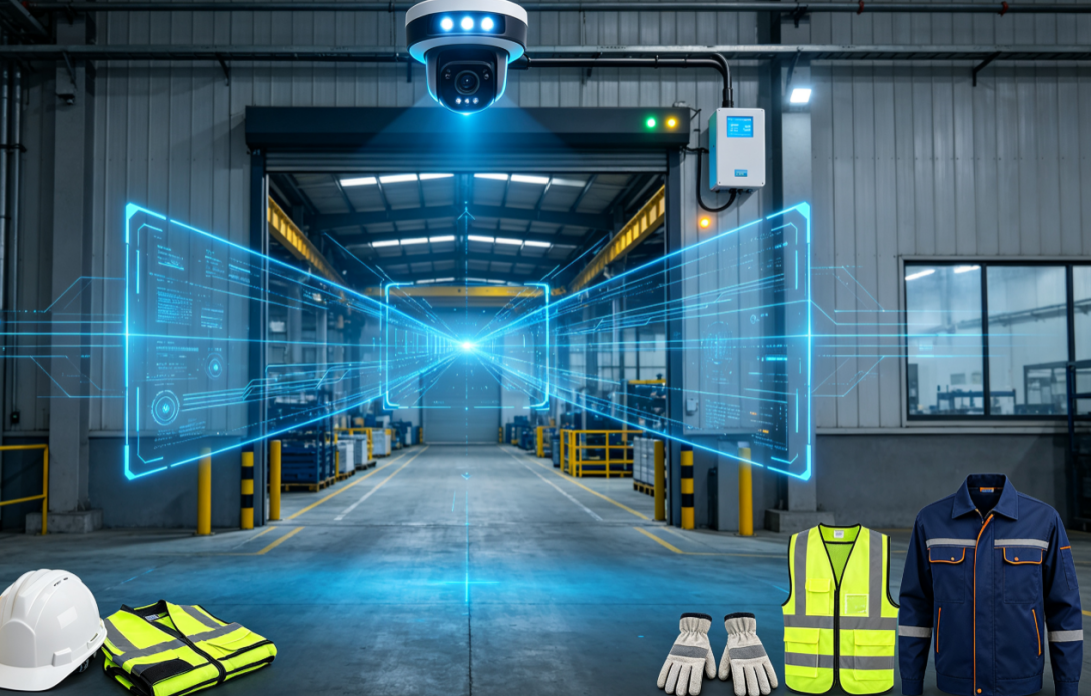
This intelligent recognition system relies solely on camera footage and identifies personal protective equipment based on visual appearance characteristics. It cannot replace safety management systems, nor can it independently guarantee on-site compliance. The device can recognize three basic types of protective equipment: safety helmet wearing status, reflective vest wearing status, and whether anti-static workwear is being worn, making determinations based on clothing color, zippers, cut, and other visual features.
The system also has multiple recognition blind spots. It cannot detect whether anti-static clothing grounding performance or protective performance meets standards. Under strong light, backlighting, personnel occlusion, excessive side angles, or when personnel are moving quickly, recognition stability drops significantly. When ordinary workwear closely resembles anti-static clothing in appearance, the device struggles to differentiate. Alerts also have a one to two second processing delay, requiring confirmation across multiple consecutive frames before a violation is determined.
The entire system adopts a three-layer edge architecture, with all data processed locally for lower latency and no external data leakage. Infrared supplementary light cameras are installed at plant entrances and exits, cleanroom passages, and work areas to achieve all-weather footage capture. Video is transmitted to edge computing devices, where target detection algorithms lock onto personnel within the frame.
A lightweight image classification model then identifies whether personnel are wearing protective equipment. The system is configured to flag a suspected violation when protective equipment is not detected across three consecutive frames. Upon recognizing a violation, the system automatically plays a voice reminder on-site, with related records simultaneously uploaded to the safety management platform. Original video analysis is immediately deleted after completion, with only desensitized screenshots retained, in compliance with data security regulations. Retained information is used solely for safety reminders and not as grounds for employee disciplinary action.
Under laboratory standard conditions, the device demonstrates excellent recognition accuracy, with 92.7% accuracy for missing safety helmet detection and 88.4% for anti-static clothing recognition. However, when deployed in real-world settings such as semiconductor and lithium battery workshops, actual effective recognition rates drop to approximately 70% due to factors including clothing reflectivity, rapid personnel movement, and equipment colors blending with backgrounds. Approximately ten false alarms occur per thousand hours of operation. Device performance varies significantly with installation height, ambient lighting, and personnel density.
The solution offers flexible deployment, supporting 4G transmission for remote plants without fiber optic connectivity. Device power consumption is below 5 watts, supporting power-over-ethernet installation. However, usage limitations exist. Small and easily obscured equipment such as masks, safety goggles, and anti-static shoes cannot be recognized. Light-colored walls paired with white safety helmets are prone to missed detection. Recognition effectiveness is poor beyond 8 meters of monitoring distance and in elevated scenarios. The total cost for single-point retrofitting ranges from 9,000 to 15,000 yuan. The industry uniformly defines this system as an auxiliary reminder tool only, and it must not be linked to access control, fines, or safety liability allocation.
The AI personal protective equipment monitoring system is merely an on-site visual assistance tool, not a safety judgment standard. It cannot eliminate safety hazards; it only makes non-compliant wearing behavior more easily detectable. The value of technology lies in moderately assisting management. The core of safety production will always be sound systems, regular training, and the safety awareness of operational personnel themselves. Intelligent algorithms can only play a supplementary role.
Source: https://cloud.tencent.com/developer/article/2625994

