


Labor protection equipment exhibition | Key Points for Scientific Reserve of Labor Protection Materials Under Extreme Weather
The Labor protection equipment exhibition notes that severe convective weather such as rainstorms, strong winds and hail has entered a high-incidence period at present, and there are many easily overlooked safety blind spots in the reserve of personal protective equipment for factory post-disaster emergency repairs.
The Ministry of Emergency Management has recently released national natural disaster data. Extreme weather not only tests the disaster resistance of factory facilities, but also brings severe challenges to personnel protection in post-disaster emergency repairs and site cleaning operations.
Natural disasters may trigger various secondary risks. Strong winds may cause high-altitude components to loosen and fall off, waterlogging in factory areas may lead to electrical short circuits, and toxic and harmful gases may accumulate in enclosed low-lying spaces.
The environment at emergency repair sites is complex, and omissions are likely to occur in conventional safety management. Scientific reserve and proper use of protective supplies serve as the final barrier to ensure the safety of operating personnel.
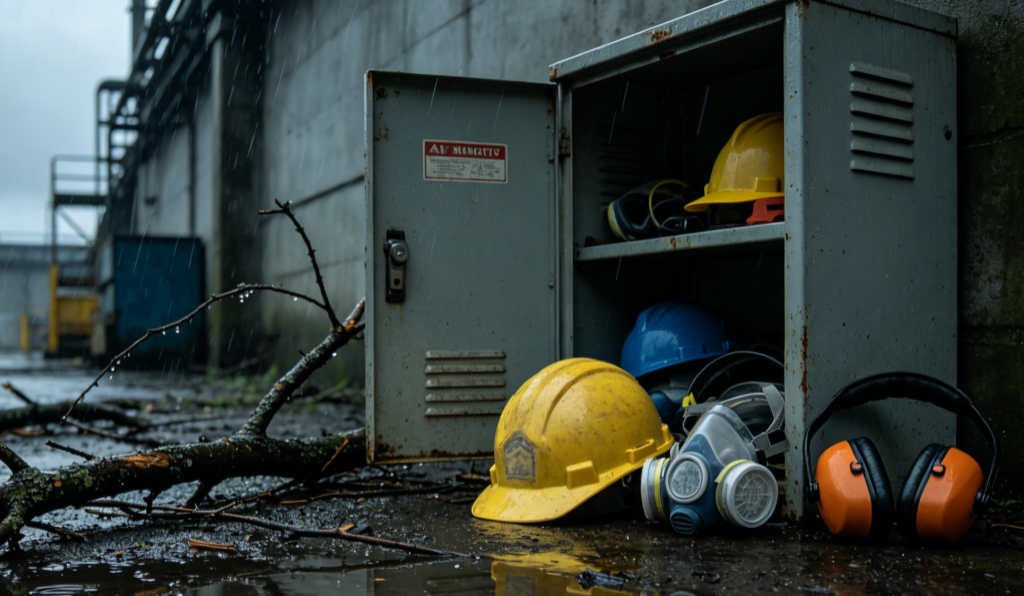
High-altitude falling objects pose risks during rainstorms and hailstorms. Staff participating in inspections and emergency repairs must wear standard safety helmets, with special checks on whether chin straps are firmly fastened.
If the chin strap is aged or not fastened tightly, the safety helmet is very likely to fall off under strong winds, rendering head protection completely ineffective and triggering serious safety accidents.
When silt and garbage are cleaned up after floodwater recedes, a large amount of dust and mold spores will be generated, and toxic gases may exist in enclosed areas. Enterprises shall reserve dust-proof masks and gas half-masks in advance based on on-site risk assessments.
Hearing protection is often overlooked by enterprises during flood-season emergency repairs. High-power water pumps and generators operate continuously and generate excessive high-decibel noise.
EHS managers shall equip maintenance workers with high-noise-reduction earplugs and earmuffs, and supervise their standard wearing on site to prevent irreversible hearing damage among employees.
Planning in advance is essential for the management of emergency protective materials. Enterprises shall set up special PPE ledgers for extreme weather, and store all types of protective supplies in dry and easily accessible emergency cabinets.
Enterprises shall regularly inspect the intact condition and service life of protective supplies, and continuously optimize the material reserve list in light of on-site risks.
Only by closely integrating risk assessment with material reserve work can factories carry out emergency repairs calmly when disasters strike and avoid safety accidents to the greatest extent.
Source: https://www.aegle.com.cn/news/news0117/

