


China Personal Protective Equipment Expo | PPE Compliance Selection Guide: Strengthening the Last Line of Defense for Occupational Safety
In high-risk industrial, construction, and chemical operations, Personal Protective Equipment (PPE) serves as the final barrier shielding workers from various hazards. Currently, many practitioners hold a rather narrow understanding of PPE, remaining at the basic level of “wear as needed, replace when damaged,” while overlooking its stringent regulatory standards, scientific selection logic, and proper usage requirements. Mastering PPE compliance essentials, category functions, and selection methodologies is fundamental to safety management and a key focus of the China Personal Protective Equipment Expo.
The production, procurement, and use of PPE are governed by explicit regulations. In September 2025, the State Administration for Market Regulation updated 42 mandatory national standards for labor protection articles, comprehensively covering eight domains: head, respiratory, eye/face, hearing, hand, foot, body, and fall protection. High-risk PPE items such as safety helmets, dust masks, and high-altitude safety belts must bear the LA safety mark to be marketed and put into use. Enterprises must verify three core elements during procurement: the product matches the applicable national standard, possesses a valid LA certification number, and the instruction manual clearly specifies the protection level and service life—firmly preventing non-compliant products from entering the workplace.
For enterprises engaged in export business, compliance with EU and internationally recognized PPE certification standards is required. EU Regulation (EU) 2016/425 classifies PPE into three risk categories: Category I low-risk products, primarily including general protective gloves and industrial sunglasses, for which manufacturers may self-declare and affix the CE mark; Category II medium-risk products, including impact-resistant goggles and conventional dust masks, requiring type examination and technical review; and Category III high-risk products, such as professional respirators, chemical protective suits, and high-altitude safety belts, which must undergo full certification by a Notified Body. Additionally, U.S. standards such as NIOSH, ANSI, and ASTM serve as common compliance benchmarks in international trade.
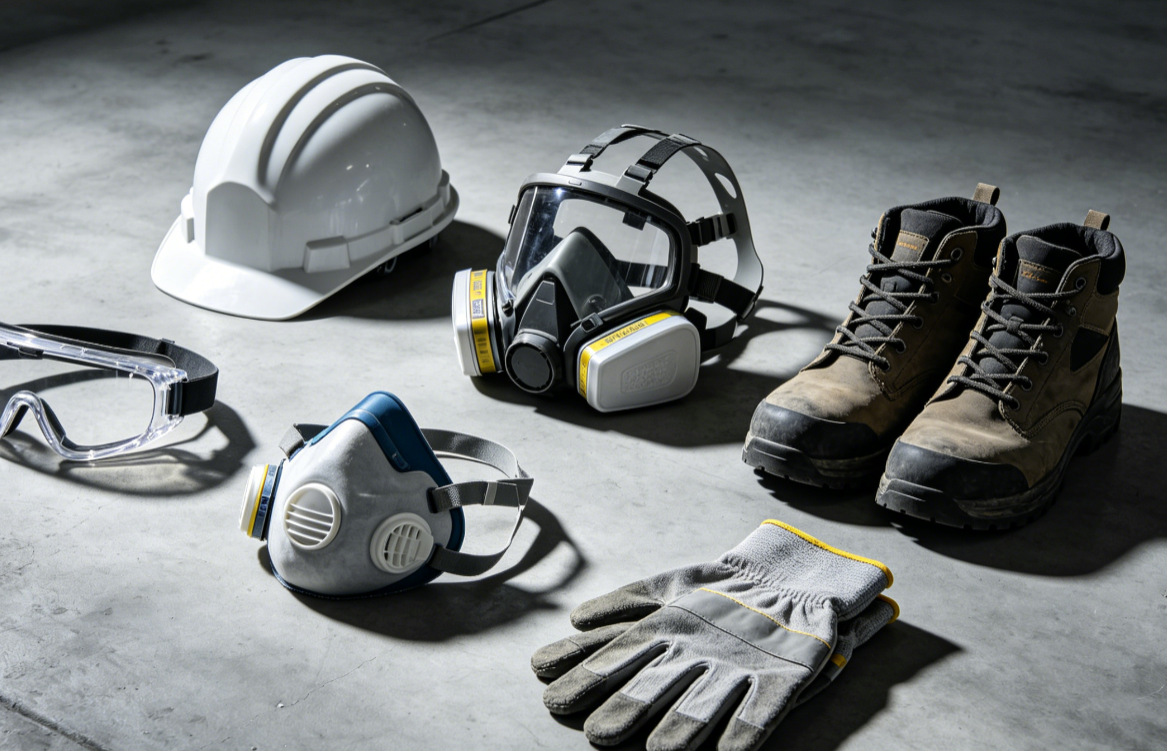
The eight categories of PPE each fulfill distinct roles, providing full-body protection for workers, with each type having clearly defined applicable scenarios and performance standards. Head protection follows GB 2811-2019, requiring 500J impact resistance and 100J puncture resistance, encompassing multiple types such as general construction, electrical insulation, low-temperature cold protection, and mining-specific helmets, adapted to different operational environments involving falling objects, electric shock, and low-temperature hazards.
Respiratory protection must be selected based on graded environmental pollutant concentrations: KN90 masks for light dust scenarios, KN95 masks with daily replacement for moderate dust processing environments, and half-face respirators with high-grade filter pads for heavy dust environments. In chemical toxic gas scenarios, professional gas masks equipped with matching filter canisters are mandatory, with strict adherence to approximately 4-hour usage limits to prevent the use of expired protection.
Eye and face protection offers targeted defense against impact, chemical corrosion, and intense light: impact-resistant goggles for mechanical operations, full-face splash guards for chemical experiments, anti-fog goggles for high-temperature and high-humidity environments, and auto-darkening welding helmets for welding operations—comprehensively safeguarding workers’ visual safety. Hand protection centers on selecting materials based on the medium: nitrile gloves for chemical and automotive repair, chloroprene rubber gloves for coatings and printing, natural rubber gloves for food processing, and cut-resistant gloves dedicated to metal processing, with each glove type having explicit contraindications that prohibit mixed use.
Body protection covers multi-scenario specialized equipment: wear-resistant workwear for general workshops, chemical protective suits graded for chemical operations, flame-resistant clothing for high-temperature metallurgy and welding, and anti-static clothing mandatory for explosive and electronics workshops. Foot protection follows GB 21148-2020, with four types of safety shoes—impact-resistant, puncture-resistant, insulated, and acid/alkali-resistant—respectively adapted to construction machinery, mining, electrical, and chemical/electroplating operations.
Hearing protection is selected based on environmental noise decibel levels: protective earplugs for 85-90 dB light noise, sound-insulating earmuffs for 90-100 dB moderate noise, and dual protection with both earplugs and earmuffs for noise exceeding 100 dB. Fall protection follows GB 6095-2021, with suspension safety belts for high-altitude work and pole-climbing safety belts for low-altitude restraint work, with accompanying safety ropes required to meet 18 kN breaking strength standards, mandatory replacement every 3 years, and routine inspection for wear and aging.
Scientific selection is key to ensuring effective PPE protection. The standardized three-step selection method can effectively prevent protection gaps. Step one is risk assessment: comprehensively identify physical, chemical, and biological hazards in the work environment, determine the risk level and exposure duration, and clarify the protected body parts and protection standards.
Source: https://www.sft-lab.com.cn/article-detail/B3L7OAxN

